

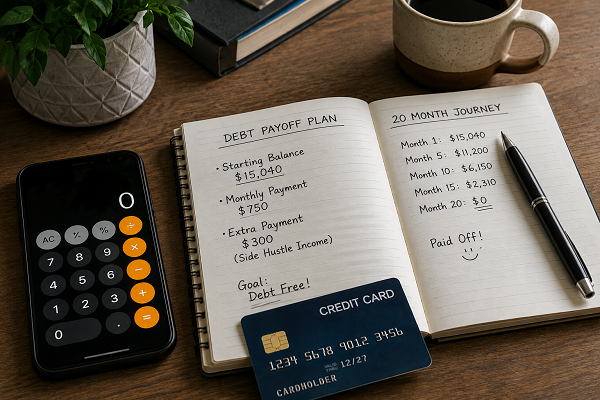
I’m Maya, I’m 30, I work as a marketing coordinator, and I live in Astoria with a roommate because doing it alone in this city was never actually on the table for me financially. Two years ago I hit a stretch where three unrelated NYC expenses landed in the same four months — a broker’s fee, a security deposit, and a root canal with no dental insurance to cover it — and I put all of it on cards because I didn’t have anywhere near enough saved. By the time I added everything up, I was carrying $15,040 across three cards.
This isn’t a “I discovered the secret” story. It’s twenty months of a spreadsheet, two slow freelance summers, one dead laptop at the worst possible time, and a payoff that happened slower and messier than I expected going in.
How NYC Specifically Got Me Here
If you haven’t rented in New York, the broker’s fee thing sounds made up. When I moved to my current apartment, I owed first month’s rent, a security deposit, and a broker’s fee — that last one alone was a full month’s rent, $2,900, just to hand over keys. Add moving costs and I’d put $6,890 on one card before I’d even unpacked.
Two months after that move, a molar I’d been ignoring turned into a root canal and crown. My dental plan covered basic cleanings and nothing close to major work. That was another $3,940, on a second card.
The third card, $4,210, wasn’t one big event — it was the slow leak of Astoria groceries, an OMNY pass, and one too many “I’m exhausted, I’ll just order in” nights during a stretch when my freelance graphic design income dried up for the summer.
None of it felt like a crisis in the moment. It just added up while I wasn’t looking closely.
The Month I Actually Looked
I finally sat down on a Sunday with all three statements open and calculated what I’d paid in interest that year alone: $2,640. Just interest — nothing off the actual balances. That number, next to my rent and everything else I was already stretched thin paying, made the debt feel less like background noise and more like an actual problem I was choosing to ignore.
The Method
I used the avalanche method — highest interest rate first, minimums on the rest. My broker’s-fee card was sitting at 24.99%, so that one went first, even though it wasn’t my biggest headache emotionally (the dental card was, oddly — I resented paying interest on a root canal more than anything else).
The Real Numbers, Month by Month
Months 1–5: I found $610 extra a month by canceling a gym membership I used twice a month, switching from grabbing Ubers when I was tired to just taking the subway, and picking up two small freelance design projects. Card A (the broker’s fee card) went from $6,890 to about $3,840.
Months 6–8: Freelance work went quiet — a common summer problem in my industry — so my extra dropped to $480/month, all from budget cuts, no side income. Card A: down to roughly $1,920.
Month 9: My laptop died. Not optional — I needed it for both my day job’s remote nights and every freelance project. A refurbished replacement cost $950. I pulled that from a small sinking fund I’d started building instead of touching my debt payments, which meant that month’s extra went toward “prevent a new problem” instead of “kill the old one.” Payoff timeline pushed back about six weeks.
Months 10–13: I picked up occasional weekend bartending shifts through a friend’s restaurant, which added roughly $560/month extra. Card A hit zero in month 13. I rolled that full payment onto Card B, the dental card.
Months 14–17: With the rolled-over payment stacked on top, Card B went from $3,940 to zero in four months.
Months 18–20: Card C, the smallest and slowest-growing balance, closed out with help from a holiday bonus at work that I put entirely toward it instead of, honestly, the trip to Portugal I’d been eyeing.
Total time: 20 months. Total interest paid: roughly $2,510, versus an estimated $5,980 if I’d kept making minimum payments the whole way through, based on a debt payoff calculator I ran at the start and checked again at the end.
The Part I’d Do Differently
I would have built even a $500 cushion before starting, instead of scrambling to create one mid-plan right before my laptop decided to die. Going in with zero buffer in a city where one dead appliance or one bounced freelance check can undo a month of progress made the whole plan feel more fragile than it needed to.
I’d also have automated the extra payments the day I started instead of transferring them manually most months. The months I did it by hand were the months I was most tempted to “borrow” $40 or $60 of that transfer for something that felt urgent at 9pm on a Tuesday and definitely wasn’t.
If You’re Doing This in an Expensive City
The numbers work differently here, and it’s worth being honest about that instead of pretending a national average budget applies. Rent, broker’s fees, and just the baseline cost of getting through a week eat into how much you can throw at debt, so the plan has to flex around slow freelance months and one-off city expenses instead of assuming a steady surplus every month. Avalanche versus snowball still matters less than picking whichever one keeps you actually making the extra payment. And build the cushion first, even a small one — the plan that survives a dead laptop or a broken sink is the one that gets you to zero.
Twenty months, three cards, and a fair amount of subway-commute grocery math later, I’m at $0. It wasn’t fast, and living in New York didn’t make it easier. But the spreadsheet and the automated transfers did more of the actual work than any single big decision did.